Yes, you can launch an AI SaaS product without writing a single line of code. More than 1,000 founders have launched globally through our system, and here is what that record shows: the tool stack is not the hard part. The operating model is. Founders who treat launching as a weekend tutorial stall before revenue. Founders who operate inside an integrated build-and-launch system reach customers faster.
What you'll learn
- What a no-code AI SaaS launch actually involves in 2026
- The kinds of AI products non-technical founders are shipping right now
- The real reason most no-code launches never reach revenue
- The five-step sequence from idea to a live, marketed product
- How to decide between building it yourself and operating inside a system
- What to prepare before you start building anything
- The single action to take this week
What launching an AI SaaS without code actually means in 2026
Launching a no-code AI SaaS means shipping a working software product that paying customers can use, without you touching engineering. In 2026 the building blocks exist off the shelf: AI models you can connect to without programming, visual builders that assemble the interface, and more than 51 AI marketing tools that handle everything downstream of the product itself.
Here is the distinction that matters. "No-code AI SaaS" does not mean you spend a weekend wiring tools together and wake up with a business. It means the technical barrier that used to require a developer or an engineering team is gone. What replaces that barrier is an operational one: getting the product in front of the right people and turning attention into revenue.
The tool stack is solved. The question is what you do with it. Your next move is to look past the platform question and ask which operating model actually carries your idea to customers.
The products non-technical founders are actually shipping
Non-technical founders are shipping focused AI tools that solve one clear problem for one clear audience. The realistic category is narrow and useful, not a sprawling platform.
Think about what AI does well: it reads, writes, answers, summarizes, and responds. That maps cleanly onto products you can build without code. A coach can ship an AI assistant that answers client questions in their voice. A consultant can ship a tool that turns a client intake form into a structured report. An agency owner can ship a branded AI chatbot that qualifies leads and books calls automatically.
These are not toy projects. They are software products people pay for because they save time or make a decision easier. The common thread is scope: one problem, one audience, one obvious reason to pay. A non-technical founder who picks a tight problem is in a strong position. A founder who tries to build a general-purpose platform is signing up for a project that will outlast their patience.
Your next move is not picking a tool. It is picking the problem.
Why most no-code launches stall before revenue
Most no-code launches stall because the founder solves the build and ignores the launch. The product gets made, and then nothing happens, because making the product was never the hard part.
Most no-code tutorials treat launching as a weekend project. Build the app, add a landing page, and customers appear. We want to push back on that narrative directly, and not to be dismissive: the build genuinely is achievable in a short window now. The problem is what the tutorial leaves out. A finished product sitting on a URL with no traffic, no ads running, no funnel, and no follow-up is not a business. It is a demo.
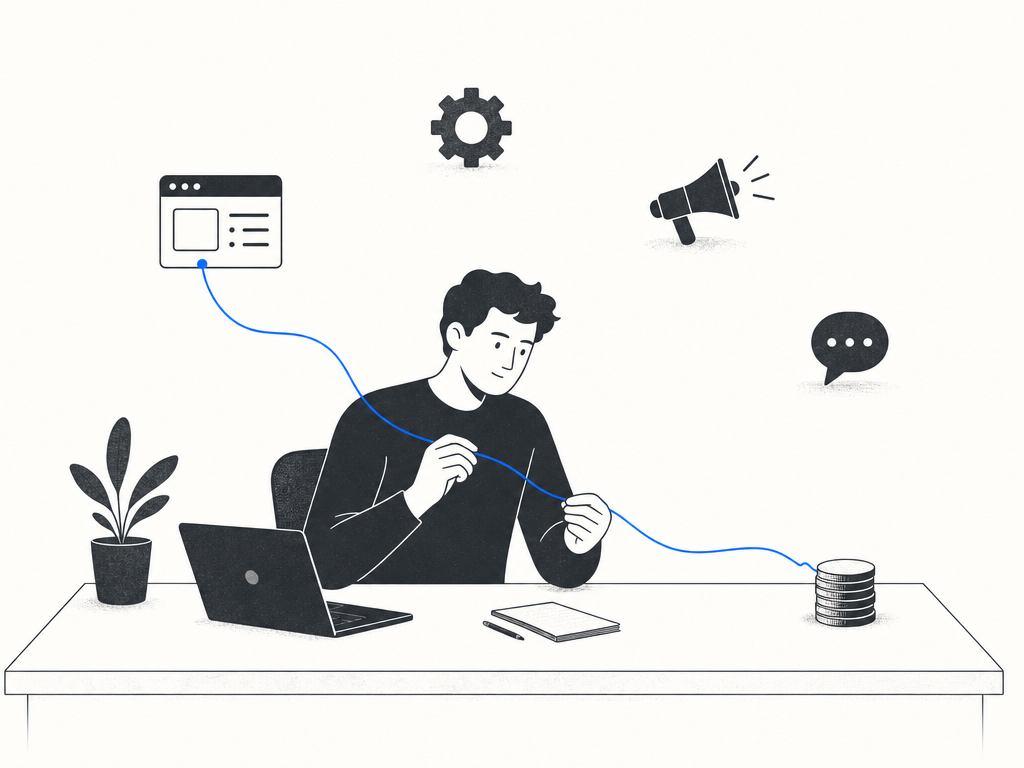
Most non-technical founders stall at exactly this point. They finish the thing and then face a second job they did not plan for: advertising across Google, Meta, and ChatGPT; building a funnel that converts a visitor into a trial; setting up WhatsApp and AI bot follow-up so interested people do not go cold; and figuring out search visibility. That is a marketing team's worth of work, and in the absence of a marketing system, the product stays invisible.
This is the gap the rest of the article is built to close. Your next step is to look at your own idea and ask whether a marketing system is attached to it, or whether the plan ends at the product.
The five-step path from idea to launched AI SaaS
The path from idea to a launched, marketed AI SaaS runs through five steps, each solving a distinct part of the problem. None of them is optional if you want customers.
Each step solves something a tutorial skips. Together they are the operating model, and the operating model, not the tool, determines whether you ship. Your next step is to look at which of these five you could realistically run alone, and which you cannot.
Build-it-yourself vs operate inside a system: how to choose
Choose based on which job you are actually equipped to do, not on which one sounds cheaper. The build is now accessible to almost anyone. The launch is not.
If you build it yourself with off-the-shelf tool stacks, you own every step. You pick the no-code platforms, assemble the product, and then personally handle ads, funnels, SEO, follow-up, and scaling. This can work when you have real marketing experience or a team already in place. When you do not, you are back at the stall point: a finished product with no engine behind it.
Operating inside a system means the build and the launch are handled together under one roof. The reason this changes outcomes is not that the tools are better. It is that most agencies do not offer the product build and the full marketing engine as one connected service. The gap between a built product and a launched one is where founders lose momentum, and an integrated system closes that gap by design.
Here is the honest framing: technical founders do have an advantage, but it is operational, not technical. They are more likely to already own the launch machinery. A non-technical founder closes that same gap by operating inside a system that owns it for them. Your next step is to decide, honestly, which steps you can run yourself and which you need handled.
What to prepare before you start
Before you start, prepare three things, and none of them is technical. You do not need to learn to code, choose a platform, or understand how AI models work under the hood.
First, prepare a sharp problem. Know exactly who you are helping and what painful, specific thing your tool fixes for them. Vague problems produce vague products.
Second, prepare an offer. Decide what you will charge and why someone would pay it. You do not need final pricing, but you need a working hypothesis about the value you deliver, because that shapes everything from the product to the ads.
Third, prepare evidence of demand, even informal evidence. Have you heard the same complaint from several people? Has anyone said they would pay to solve it? When you have validated demand before build, the whole process runs faster because you are not building on a guess.
That is the preparation. A clear problem, a working offer, and a signal that people want it. With those three in hand, you are ready for a strategy conversation.
Your next step
This week, write down the one problem your AI tool will solve and the one audience it serves, then pressure-test it before you build anything. That single action moves you from thinking about a product to validating one.
You do not need to code. You do not need a team. You need a sharp problem and an operating model that carries it all the way to customers. Book your free strategy call.
Frequently asked questions
What does "no-code AI SaaS" actually mean in practice?
What kinds of AI products can realistically be built without code?
Why do most no-code launches stall before revenue?
Should I build the product myself or operate inside a done-for-you system?
How long does it take to go from idea to a working AI SaaS product?
What do I need to prepare before starting?
Ready to launch your AI SaaS?
Join 1,000+ founders who skipped the stall and launched with Trivro SI. Book a free strategy call and leave with a clear, personalized plan.
Book My Free Strategy Call