Yes, a non-technical founder can launch an AI business in one day, but only when build, marketing, and automation run under one operating team. That is how 1,000+ founders have launched globally. Below: what gets built on day one and what continues after.

A note on where this comes from: Trivro SI publishes this article and the operating data referenced here comes from the platform's own work with founders. The relationship is worth naming so readers can weigh the data with that context.
Why one-day is real now and was not before
A one-day launch is feasible in 2025 because the hard parts are already built, not because the work got smaller. Two years ago, launching an AI product meant hiring a developer to wire up the model, a designer for the funnel, and an agency for the ads. Each handoff added weeks. Today the tooling has matured. Trivro SI has built and deployed 51+ AI marketing tools in-house, which means the components a founder would otherwise commission from scratch already exist and connect.
Here is the shift in plain terms. The product logic, the funnel templates, the ad account structure, and the automation flows are no longer custom jobs. They are assets a single team can configure to your business in hours. When the model that answers your customers, the page that sells them, and the bot that follows up all live under one roof, the timeline collapses from months to a working day. This is not magic and it is not a shortcut around the work. It is the difference between building a house from raw lumber and assembling one from pre-made, tested parts.
What gets built on launch day
Launch day produces a live, revenue-ready AI business: a working product, a funnel that can take payments, and the first layer of automation behind it. This sits inside Trivro SI's documented five-step process, which runs from strategy call, to product build, to marketing launch, to automation, to ongoing scaling.
The product comes first. If your idea is a coaching chatbot, a document tool for consultants, or a no-code app for your niche, the team builds it so you do not write code. You describe what it should do. The team makes it do that. Then comes the funnel. A landing page goes live. Payment is connected. The page is written to sell the specific thing your product does, not a generic template with your logo pasted on.
None of this requires a technical background from you. You do not need to know how an API works or what a database is. When a technical concept comes up, it gets translated into a decision you can actually make: not "configure the webhook," but "where should new customer alerts go." That is the whole point of a done-for-you build. The technical skill lives with the team. The business decisions stay with you.
How marketing and automation go live the same day
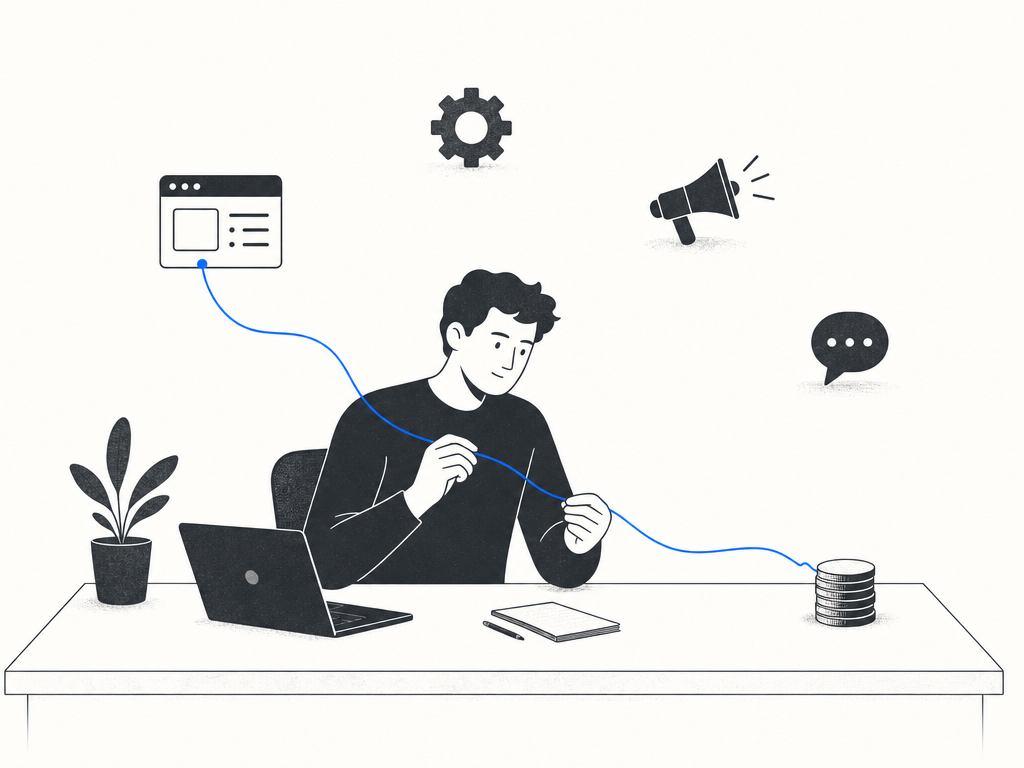
Marketing and automation are set up on launch day alongside the product, which is what makes the business revenue-ready rather than just live. A product with no way to reach customers is a half-launch. On day one, ads, funnels, SEO, and automation go up on the same surfaces your customers already use: Google, Meta, ChatGPT, and WhatsApp.
The ads give you traffic. The funnel turns that traffic into buyers. The automation handles what happens next without you sitting at a keyboard. WhatsApp automation and an AI bot answer questions, qualify leads, and follow up while you sleep. If you want to understand how these pieces convert launch-day traffic and run sales on autopilot, the AI funnels, WhatsApp automation, and ad platforms for new AI businesses cluster covers the funnels, chatbots, and ad platforms in depth.
The reason this works in one day is the same reason the product does. Most agencies sell these services separately, so you wait on one vendor to finish before the next one starts. When build, marketing, and automation are executed by one team, there is no handoff and no waiting. The funnel is written knowing what the product does. The automation is wired knowing what the funnel promises. The parts fit because the same people built them.
Launching is not scaling, and why that honesty matters
Launching and scaling are two different things, and a one-day launch delivers the first, not the second. This is where many fast-launch promises go quiet. The industry loves to sell speed and stay silent on what growth actually costs in time and attention. We will not do that here.
Day one gives you a working business: product live, funnel taking payments, automation running. What it does not give you is a scaled or profitable business on day one. Scaling is ongoing work. It is testing ad angles, refining the funnel against real buyer behavior, expanding into new markets, and building the authority that makes buyers trust you. For coaches and consultants especially, that trust comes from a personal brand built over time. The personal branding and book publishing track for AI founders covers how founders build that authority alongside their AI product, because a launched product and a known founder are not the same asset.
Being clear about this is not a hedge. It protects you. If you expect day one to produce revenue at scale, you will quit in week two when it does not. If you expect day one to produce a live business you then grow, you will stay and do the work that actually compounds.
Which AI businesses fit a one-day launch
An AI business fits a one-day launch when its scope matches a no-code build rather than custom infrastructure. The clearest fits are coaching bots, consultant tools, course-adjacent AI apps, agency service products, and niche no-code SaaS where the AI does a specific, well-defined job. Founders have launched AI SaaS and no-code apps across many industries using exactly this model.
What takes longer? Anything that needs custom infrastructure, complex integrations with legacy systems, regulatory approval, or a product whose core value depends on proprietary technology built from the ground up. In the absence of those requirements, your idea likely fits a one-day build. When those requirements are present, the strategy call will tell you so honestly rather than forcing your idea into a timeline it does not fit.
The honest framing is this: the one-day timeline is for a defined category of business, not every idea anyone could have. The strategy call exists partly to sort this. It is not a sales formality. It is the step where your specific idea gets matched to what a build day can actually deliver.
What to prepare before your launch day
Prepare three things before the strategy call so launch day runs without stalling: a clear offer, your audience, and your assets. The strategy call is the first step of the five-step process, and the clearer you arrive, the more the build day delivers.
Know your offer. What does your AI product do, for whom, and what do they pay. You do not need a polished pitch. You need to know who you are serving and what problem you solve. Know your audience. Where do your buyers already spend time, and what language do they use. This shapes the funnel copy and the ad targeting. Know your assets. Any existing content, customer list, domain, or brand you already have shortens the setup. If you have none, that is fine. It is just useful to know going in.
What you do not need to prepare is anything technical. You do not need a tech stack, a developer on standby, or a marketing plan in a spreadsheet. The preparation is about clarity on your business, not readiness on the tools. The tools are the team's job. The clarity is yours.
Book your free strategy call to scope whether your idea fits a one-day launch and what your day one would actually build.
Book your free strategy callFrequently asked questions
Can a non-technical founder really launch an AI business in one day without coding?
Yes, when the product build, marketing, and automation are handled by one operating team rather than separate vendors. The founder makes business decisions; the team handles every technical step. This model has launched 1,000+ founders globally. The one-day timeline applies to businesses whose scope fits a no-code build, which covers coaching bots, consultant tools, and niche AI apps. Ideas needing custom infrastructure take longer, and the strategy call sorts which category your idea falls into.
What does a one-day AI business launch actually include?
It includes a working AI product, a live funnel connected to payments, and the first layer of automation behind it. Marketing goes up the same day: ads on Google and Meta, a funnel that converts traffic, SEO, and WhatsApp automation that follows up with leads. This produces a live, revenue-ready business. It does not produce a scaled or profitable business on day one. Revenue at scale comes from the ongoing growth work that follows launch day.
What is the difference between launching and scaling?
Launching gives you a live business: product, funnel, and automation running. Scaling is the ongoing work of growing it: testing ad angles, refining the funnel against real buyer behavior, expanding into new markets, and building founder authority. The one-day claim applies only to launching. Scaling has no fixed timeline because it depends on your market, offer, and consistency. Treating day one as the finish line is the mistake that ends launches early. Treat it as the starting line instead.
What technical skills do I need to launch an AI product this way?
None. You do not need to code, understand APIs, or manage a tech stack. Technical work lives entirely with the team. Your role is business decisions: what the product does, who it serves, and how it sells. When a technical concept comes up, it gets translated into a plain decision you can make, such as where customer alerts should go rather than how to configure a webhook. The whole model exists so founders without a technical background can run an AI business.
What should I prepare before the strategy call?
Prepare clarity on three things: your offer, your audience, and your assets. Know what your product does, who pays for it, and what problem it solves. Know where your buyers spend time and what language they use, which shapes funnel copy and ad targeting. Gather any existing content, domain, customer list, or brand you have, since these shorten setup. You do not need anything technical or a marketing plan. The preparation is about understanding your business, not readiness on tools.
What kinds of AI businesses fit a one-day launch?
Businesses whose scope matches a no-code build fit best: coaching bots, consultant tools, course-adjacent AI apps, agency service products, and niche no-code SaaS where the AI does a specific, defined job. Founders have launched across many industries this way. Ideas needing custom infrastructure, complex legacy integrations, regulatory approval, or ground-up proprietary technology take longer. The strategy call matches your specific idea to what a build day can deliver, so you get an honest answer before committing rather than forcing an idea into the wrong timeline.